


Master the Blueprint: Become the Architect of Your Credit Score
That’s fine. We’ll spell them out. Then you stop hoping, and you start building.Think of your score like a set of plans pinned to a corkboard. Not a lottery ticket. Not a mood ring. A blueprint.
When you know which sections carry the most weight, you nudge the right beams and watch the whole structure get sturdier.
No magic. Just math and timing. And a little discipline.
Blueprint, Not Weather
Most people refresh a score once a month, see a small dip, and assume lightning struck. Nothing changed, right?
Except something did. A balance reported on the wrong day. A new inquiry you forgot about. An old address still clinging
to your file like duct tape residue. The system isn’t random; it’s just quiet. So you miss the levers.
Call it a construction project. You pick materials, you schedule work, you lock the doors at night. Same with credit.
Make the right changes and new doors crack open—better card offers, smaller car payments, real mortgage options—because
lenders price risk, and a clean file looks less risky. That’s all this is.
The Five Levers That Actually Move Your Score
Lenders don’t consult a crystal ball. They rely on scoring models, and the one that matters most is FICO.
It’s the one pulled across the desk in most lending decisions, and it weights five buckets of data:
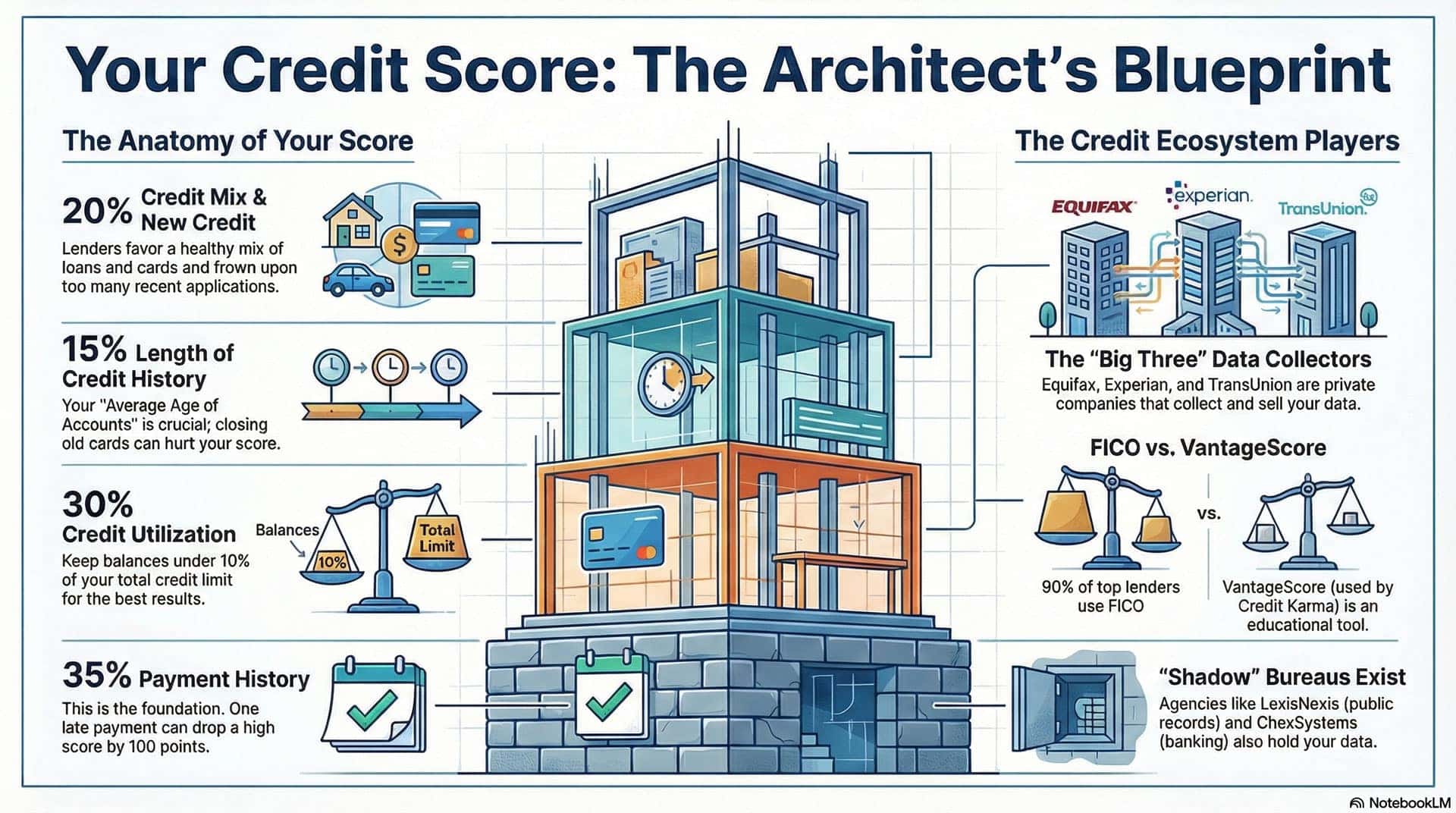
Payment history (35%). Amounts owed—what most people call “utilization” (30%). Length of credit history (15%).
New credit (10%). Credit mix (10%). If you had time to fix just one thing, you’d start with the top two.
They swing the biggest hammers.
-
Payment History — 35%
This is the foundation slab. Do you pay on time, every time? Thirty days late on a pristine file can bruise you fast—sometimes by a gut-punch amount—
because the model reads “late” as “risk.” Misses also linger. They age, sure, but they don’t vanish overnight.Practical move: set Auto-Pay for at least the minimum on every revolving account. You can still pay more—do it before the statement closes—
but Auto-Pay keeps the concrete from cracking. FICO’s own materials say payment history carries the heaviest weight, which tells you where to focus first. -
Utilization — 30%
This is speed. You want quick movement? Move this number. Utilization = reported balances divided by credit limits.
Let’s say your card limits total $10,000. A $2,500 reported balance means 25% utilization. Lower is better.
Under 30% is the common advice. Under 10% is where things start to sing.Key detail most people miss: the number that matters is the reported balance on your statement date, not what you owe five days later.
So you can use your card, reap the rewards, then pay it down before the statement cuts. The bureaus see the lower figure and the model rewards you. -
Age of Credit — 15%
Time helps. Old, boring accounts help more. Your oldest card is like the original corner post on a house: you don’t yank it out for fun.
Keep it open unless there’s a real reason to close. Every new account also lowers your average age, so open new lines with intention. Not boredom. -
Credit Mix — 10%
Show you can handle different tools. Revolving (credit cards) plus installment (auto loan, mortgage, student loan).
You don’t need one of everything. You don’t open loans for the sake of “mix.” But if your file is nothing but two cards,
adding one well-priced installment account down the road can round out the picture. -
New Credit — 10%
Inquiries and new lines cluster? The model pays attention. Too many applications, too fast, looks like you’re hunting for lifelines.
Space them out. When you actually need a new account, fine—apply. Just don’t ping your report every other week because a pop-up ad waved a bonus at you.
Who Tracks You vs. Who Scores You
Two separate worlds here.
Collectors. Equifax, Experian, and TransUnion maintain the files. They gather data from furnishers (banks, card issuers, lenders),
compile it, and sell access to it. They are private companies. They are not the government. They maintain big, imperfect databases tied to your identity.
Scoring models. Companies take the raw file data and compute a number. The best-known model is FICO, and it’s the one most lenders pull
when underwriting loans and credit. Your banking app may show VantageScore for education, which is fine. Just expect a difference.
Different math, different number. FICO remains the dominant standard across lending decisions, even as score versions evolve by industry
(auto, mortgage, bankcard) and by bureau.
The Not-So-Secret “Secondary” Bureaus
Everyone knows the Big Three. Fewer people know the specialty databases—secondary bureaus that track narrower slices of your life.
Lenders check them for identity, fraud, banking behavior, public records, and more. A few names you should actually recognize:
- LexisNexis. Big public-records warehouse. Insurance claims data. Identity data. Vendors across finance use it for cross-checks.
You can request your consumer file and place a security freeze through LexisNexis Risk Solutions. - ChexSystems. Banks look here when deciding whether to open you a checking account. Bounced checks, unpaid fees, suspected fraud—this is
the file that can block you from basic banking. (Yes, you can freeze this report too.) - Innovis. Think of it as the “fourth bureau.” Smaller footprint than the Big Three, but lenders and identity services use it.
Innovis supports security freezes you can place or lift online. - SageStream. A specialty consumer reporting company now part of LexisNexis Risk Solutions. Requests for security freezes route through
LexisNexis’ consumer center.
Why you care: during disputes and underwriting, these files get pinged. If your data here is messy—or too accessible—mistakes travel faster.
You’re allowed to order disclosures, correct errors, and freeze access so third parties can’t freely pull the reports without your say-so.
The CFPB’s running list of consumer reporting companies is a good directory if you want to see who else holds a file on you.
The Two-Day Architect Plan
You don’t need a semester. Give yourself 48 focused hours and set the bones. Four moves. No fluff.
Build Your Master Credit Folder
Digital, physical, or both. Name it something obvious—Credit_Master—and park it somewhere you won’t lose. Inside: subfolders for IDs, reports, disputes, and notes.
You won’t memorize details; you’ll organize them. That saves you from chasing logins and re-answering security questions for the fourth time this year.
Lock Down Identity Basics
Drop three files into that folder: Photo ID (driver’s license or passport). Social Security card. Proof of address (recent utility bill, bank statement, or pay stub).
Scan to PDF. Label them cleanly: ID_JD_2026-01-05.pdf, etc. Lenders and bureaus ask for these on disputes and freezes. You’ll have them ready. No hunting.
Pull Full Reports (Not Just a Score)
Head to AnnualCreditReport.com. That’s the official portal the law requires the nationwide bureaus to use for free reports. Get all three: Equifax, Experian, TransUnion.
Download the PDFs. Save them in your folder with dates. If a site tries to sell you a “free” report somewhere else, skip it—the authorized place is AnnualCreditReport.com.
Run a Pre-Audit Scan
You’re not disputing yet. You’re spotting loose bricks. Identity header. Open accounts. Negative items. Hard inquiries. Make a checklist.
Don’t argue with anything yet. Just list, date, and tag by bureau.
Where This Goes Next
You’ve got the blueprint and a clean workbench. You know who collects your data, who scores it, and which levers throw the biggest shadows.
You’ve grabbed the quick wins (utilization, organization) and set barricades where you need them (freezes).
Next up is Module 2: The Audit Phase—line-by-line cleanup, documentation, and disputes that actually stick.
Important: The strategies shared in this video are educational suggestions only and do not constitute financial, legal, or credit repair advice.
Credit scoring is highly individual; therefore, results are not guaranteed and will vary based on your unique financial history.
We are not a credit repair organization or a financial advisory firm. Use this information at your own risk and consult with a professional for specific financial decisions.
For our full legal disclosure, please see the bottom of this page.