


The Investigator’s Audit: Turn Your Credit Report into a Case File
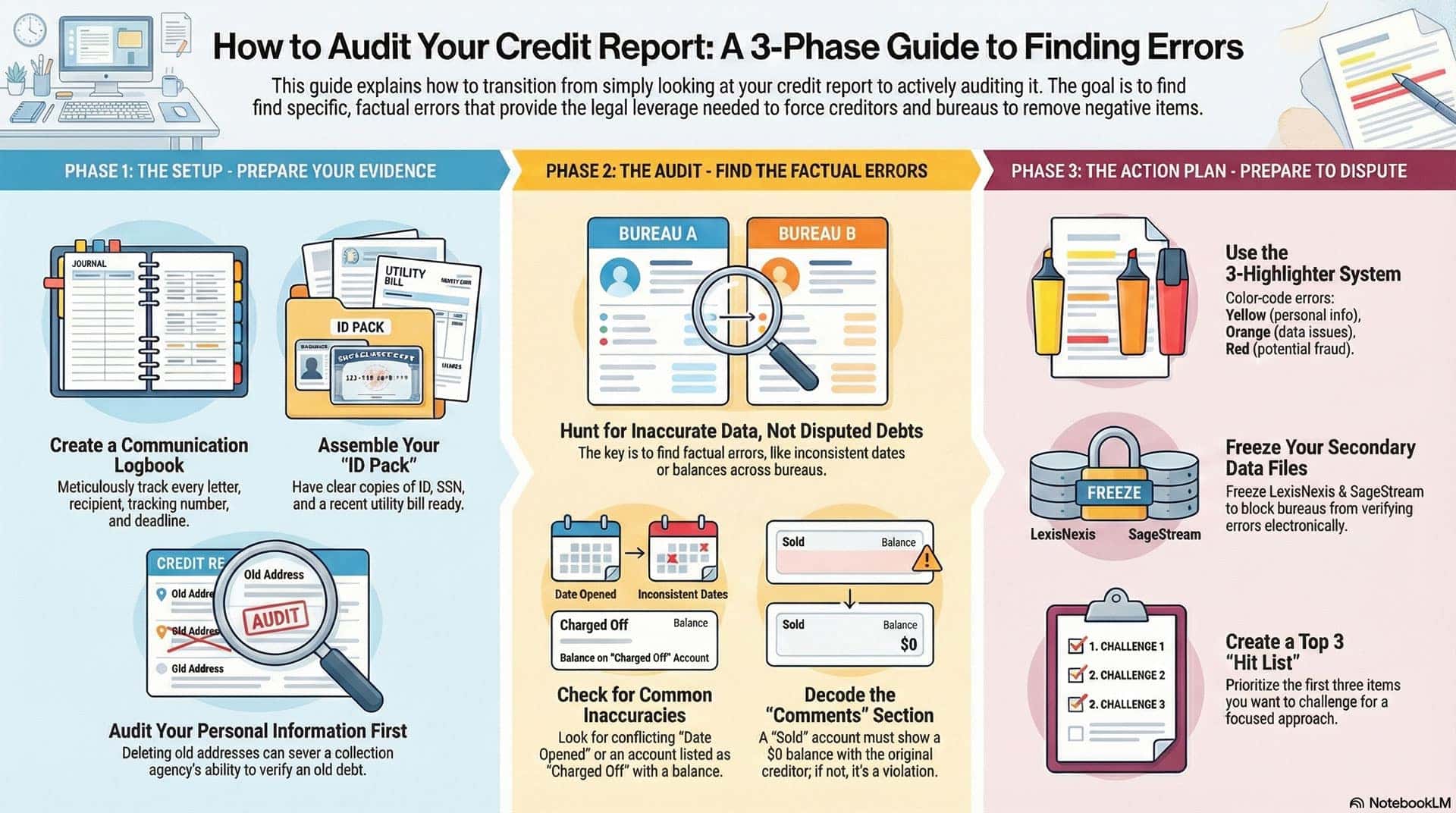
Your credit report isn’t a summary. It’s evidence. Treat it like a file you’re building for court. Stop skimming and start investigating—line by line—for every crack:
bad dates, stale addresses, sloppy balances, claims no one can prove. This module moves you from knowing the scoring rules to auditing the data with precision.
Step 1: Build Your Toolkit
You don’t need fancy software. You need order.
- Logbook. Record every move—dates, certified mail numbers, who you sent, who signed. If it’s not logged, it didn’t happen.
- ID Pack. Cut off stall tactics before they start. Include clear copies of your photo ID, Social Security card, and a current proof of address with your first dispute letter.
- Paper Trail. Documentation is leverage. Save PDFs, scans, envelopes, green cards—everything. Your file should answer questions before anyone asks them.
Step 2: Clean Up Personal Information
Skip the negatives for a moment. Start at the top.
- Fix the identity tangle. Flag every wrong name, spelling, extra middle initial, and outdated employer. Keep only your correct legal name and current details.
- Address strategy. Old addresses tie debts to you. Remove the ones you no longer use. If a collector can’t link a record to a current, verified address, verification gets a lot harder.
Step 3: Fact-Check Every Trade Line
Now the accounts. You’re not debating feelings—you’re hunting for facts.
- Match across bureaus. Compare Equifax, Experian, and TransUnion. Do the open dates line up? Are balances and limits consistent? Different “last updated” dates? Document each mismatch.
- Accuracy is the rule. Data must be complete, accurate, and provable. Any inconsistency is grounds to challenge.
- Transferred or sold? If the comment says “transferred” or “sold,” the original creditor reports a $0 balance. If they still show money owed, you’ve got leverage—note it and pull statements to back it up.
Step 4: Run the Freeze Protocol
When you dispute, the Big Three often lean on shortcut databases to “verify.” Cut that path.
Freeze the specialty files (e.g., LexisNexis, SageStream) before you submit disputes. A freeze forces a real look at the records instead of a quick electronic match.
Real reviews take time—and weak items crack under the deadline.
Your 3-Step Homework
- Highlight session. Print your reports. Color-code: Yellow for identity errors, Orange for account inconsistencies, Red for fraud or unknown items.
- Freeze protocol. Place security freezes with LexisNexis and SageStream. Save confirmations and PINs in your logbook.
- Target list. Pick the top three items to attack first—the ones with the clearest errors or the biggest score drag.
You’ve built a case file. You’ve mapped the weak joints. You’re not a passive reader anymore. You’re the investigator, and the record now has to answer to you.
Legal Disclaimer & Disclosure
-
Educational Purposes Only.
The information provided on this website, including all videos, text, 48-hour plans, and downloadable resources (collectively, the “Content”),
is for general educational and informational purposes only. The Content is designed to help users understand the mechanics of credit scoring and
is not intended to serve as legal, financial, or tax advice. We are not a law firm, a credit repair organization as defined under federal or state law,
or a financial advisory service. -
No Guarantee of Results.
Credit scoring is a complex process involving proprietary algorithms owned by third parties (such as FICO and VantageScore) and data maintained by
independent credit reporting agencies (Equifax, Experian, TransUnion, etc.). Because every individual’s financial history and credit profile are unique,
we cannot and do not guarantee any specific increase in your credit score or any specific financial outcome. The “suggestions” and “levers” discussed
are based on general industry trends and may not yield the same results for all users. -
Accuracy of Information.
While we strive to provide up-to-date and accurate information, credit laws (such as the Fair Credit Reporting Act) and scoring models change frequently.
We make no representations or warranties, express or implied, regarding the completeness, reliability, or accuracy of the Content. Any reliance you place
on such information is strictly at your own risk. -
Not a Substitute for Professional Advice.
The Content is not a substitute for professional advice from a qualified financial planner, certified public accountant, or attorney. If you are facing
significant financial distress, bankruptcy, or legal action regarding your debts, you should consult with a licensed professional in your jurisdiction. -
Third-Party Links and Services.
This page may reference third-party websites such as AnnualCreditReport.com or secondary bureaus like LexisNexis. We do not control, endorse, or assume
responsibility for the content, privacy policies, or practices of any third-party sites or services. -
Limitation of Liability.
In no event shall the creators, owners, or affiliates of this website be liable for any direct, indirect, incidental, or consequential damages resulting
from the use or inability to use the Content provided, even if advised of the possibility of such damages.