


Your High-Score Maintenance Plan
You Hit 700. Now Act Like It.
You didn’t luck into a 700+ score—you built it. Brick by brick.
Now the mission changes. You stop patching leaks and start fortifying walls. And when you move, you move like someone who plans to keep the high ground.
This isn’t maintenance for the sake of maintenance. It’s control.
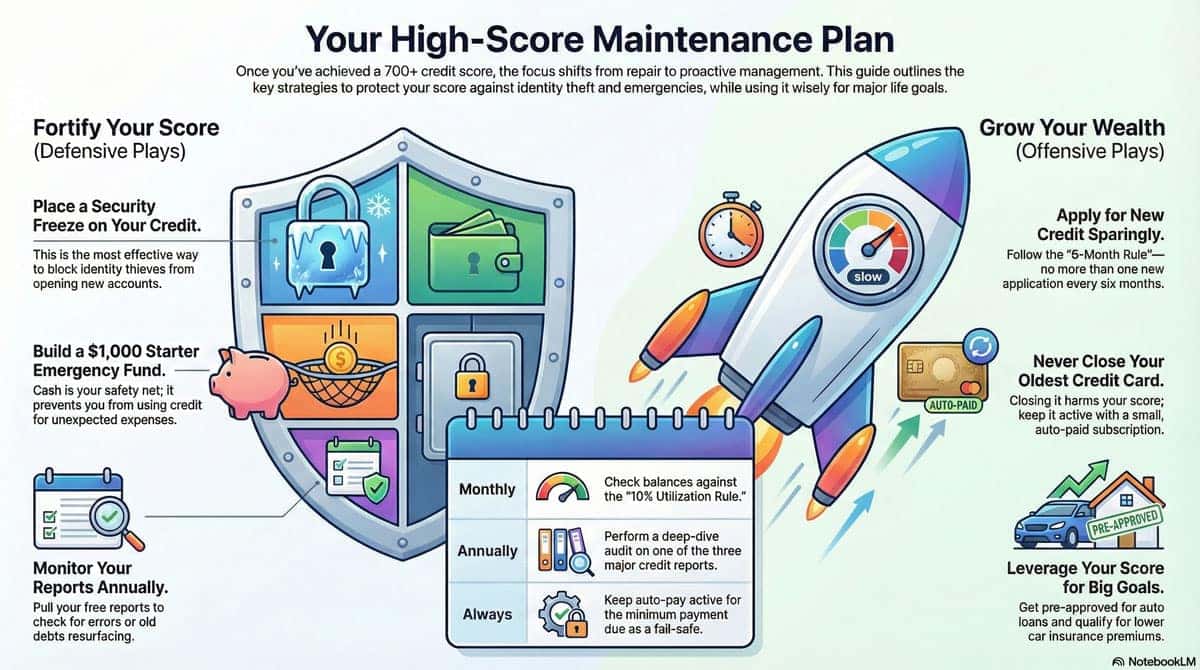
1) Lock the Gates: Freeze First, Ask Questions Later
A strong file attracts attention—good and bad. Lenders court you. Fraudsters sniff around. The biggest threat to a clean 700 isn’t a forgotten $27 minimum;
it’s a stranger opening a fat line in your name while you’re at lunch.
Security Freeze > Fraud Alert
- Security Freeze: A hard stop. No one opens new credit—including you—until you lift the freeze. Think drawbridge up.
- Fraud Alert: A courtesy flag. Extra verification, but doors can still open.
Use the freeze as your default. You can thaw it for a day or a week when you actually apply. Ten minutes to lift. Ten minutes to re-freeze.
That habit alone prevents a thousand headaches.
2) Grow on Purpose, Not Impulse
You’re “prime” now. That mailbox? It’s about to drown in 0% promos and bonus bait. Most of it looks shiny. Most of it isn’t for you.
The Every-6-Months Rule
Applications trigger hard inquiries and lower your average age. Stack a bunch, and you look jumpy.
Solution: no more than one new account every six months. You stay selective. Your file stays calm.
Never Close Your Oldest Card
That starter card with weak perks? It’s still the oldest beam in your house. Pull it and the structure shifts.
- Keep it open.
- Put one small, recurring charge on it (cloud storage, streaming).
- Auto-pay the statement in full.
- Forget about it—on purpose.
You preserve age, protect utilization, and avoid “inactive account” closures from the issuer.
3) Build a Moat Before You Build Towers
A great score without cash is a sandcastle. One surprise—tire blowout, co-pay, slow month—and you lean on cards, spike utilization, and watch points slip.
Start with a $1,000 starter emergency fund. Quick. Boring. In a separate account. That cushion keeps balances from creeping up when life gets loud.
Then, while the moat holds, you make your score pay you back.
Turn 700+ Into Cheaper Everything
- Mortgages: Lenders use your middle score (the one in between the other two). Clean reports across all bureaus, line up docs,
and rate-shop the same week so inquiries group together. - Auto loans: Get credit union pre-approval before you set foot on a lot. You walk in with a rate. Dealers stop “spraying” apps
to ten lenders and you stop collecting hard pulls like souvenirs. - Insurance: Many carriers price with a credit-based score. Ask your current provider to re-rate your policy at renewal.
Shop it if they won’t budge.
4) Keep Utilization on a Short Leash
Your score loves low ratios. Treat statement dates like deadlines.
- List each card’s limit and statement date.
- Pay balances 3–5 days before statements close.
- Aim to report under 10% on each card. If that’s steep, drop below 30% first, then grind down.
- Remember: what matters is the number that reports, not the number you pay two days later.
5) Your Maintenance Schedule (15 Minutes a Month)
| Frequency | Do This | Why It Matters |
|---|---|---|
| Monthly | Check each card’s reported balance vs. the 10% rule. Adjust payments before statement dates. | Keeps scores steady and surprises rare. |
| Quarterly | Scan reports for weird soft inquiries or new addresses. | Early warning on sloppy data or identity issues. |
| Annually | Deep-audit one bureau report line by line. Rotate next year. | You catch creeping errors before they spread. |
| Always | Keep Auto-Pay set to at least the minimum on every account. | Late payments erase months of good work. |
Set calendar reminders. Make it muscle memory.
6) Add Credit the Smart Way
When you do open something new, make it count.
- Big limits, low fees. A single high-limit card can help utilization more than three mediocre ones.
- Real benefits. Pick perks you actually use—travel protections, extended warranties, solid cash-back—so the card earns its drawer space.
- Product changes over closures. If a card stops fitting, ask the issuer to “product change” to a no-fee version instead of closing. You keep history without paying annual fees.
7) Guardrails You Don’t Remove
- Freeze stays on by default. Thaw only when you’re applying.
- Alerts set on card apps for transactions and balance thresholds.
- No autopay for minimums alone if you tend to forget—pair it with a second, mid-cycle push for the utilization drop.
- No balance carries at sky-high APRs just to chase points. Rewards don’t out-earn 24.99%.
8) When Life Throws a Curveball
Something big hits and cash gets tight? You prioritize in this order:
- On-time payments (even minimums). Payment history runs the show.
- Utilization triage. Keep at least your highest-limit card reporting under 10–30% to steady the ship.
- Talk early, in writing. Hard moments happen. Hardship programs exist. Document everything and protect your file while you catch up.
9) Small Habits, Big Score
- Name your goals. Mortgage in 12 months? New lease in 3? Work backward. Build timelines so your freezes, thaws, and applications line up.
- One new account at a time. Let it age three months before adding another.
- Statement-date calendar. Share it with your phone, your partner, your fridge—whatever keeps you honest.
- Annual “credit hour.” Once a year, sit down, pull all three reports, and read them like you’re paid to find mistakes.
- Boring wins. Every time.
10) What You Don’t Need Anymore
- Endless disputes on clean files. Save the energy for real errors.
- Closing cards out of spite. Downgrade, sock-drawer, move on.
- Rate panic. You qualify widely now. Shop calmly. Make lenders earn your business.
You Built the Walls. Now Use the Keys.
Seven hundred isn’t a finish line. It’s a lever. You’ve got cheaper money, better terms, and more doors unlocked than you’ve ever had—use them on purpose.
Freeze the file until you move. Spend like balances will get published on a billboard (because they will—on statement day). Keep the oldest line alive.
Keep the calendar close.
You didn’t just join a club. You built a fortress. Now make it pay.
Ready for a new ride?
Legal Disclaimer & Disclosure
-
Educational Purposes Only.
The information provided on this website, including all videos, text, 48-hour plans, and downloadable resources (collectively, the “Content”),
is for general educational and informational purposes only. The Content is designed to help users understand the mechanics of credit scoring and
is not intended to serve as legal, financial, or tax advice. We are not a law firm, a credit repair organization as defined under federal or state law,
or a financial advisory service. -
No Guarantee of Results.
Credit scoring is a complex process involving proprietary algorithms owned by third parties (such as FICO and VantageScore) and data maintained by
independent credit reporting agencies (Equifax, Experian, TransUnion, etc.). Because every individual’s financial history and credit profile are unique,
we cannot and do not guarantee any specific increase in your credit score or any specific financial outcome. The “suggestions” and “levers” discussed
are based on general industry trends and may not yield the same results for all users. -
Accuracy of Information.
While we strive to provide up-to-date and accurate information, credit laws (such as the Fair Credit Reporting Act) and scoring models change frequently.
We make no representations or warranties, express or implied, regarding the completeness, reliability, or accuracy of the Content. Any reliance you place
on such information is strictly at your own risk. -
Not a Substitute for Professional Advice.
The Content is not a substitute for professional advice from a qualified financial planner, certified public accountant, or attorney. If you are facing
significant financial distress, bankruptcy, or legal action regarding your debts, you should consult with a licensed professional in your jurisdiction. -
Third-Party Links and Services.
This page may reference third-party websites such as AnnualCreditReport.com or secondary bureaus like LexisNexis. We do not control, endorse, or assume
responsibility for the content, privacy policies, or practices of any third-party sites or services. -
Limitation of Liability.
In no event shall the creators, owners, or affiliates of this website be liable for any direct, indirect, incidental, or consequential damages resulting
from the use or inability to use the Content provided, even if advised of the possibility of such damages.